



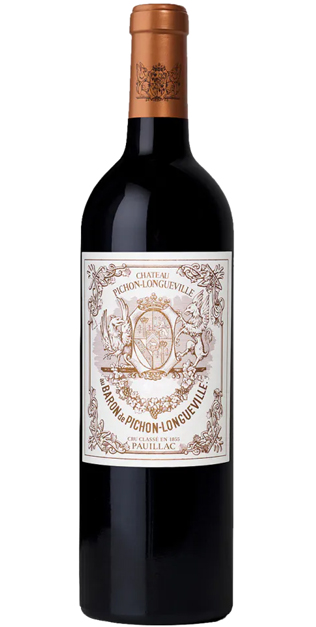
CHÂTEAU PICHON BARON 2017
| Wine Country | |
|---|---|
| Wine Region | |
| Wine Appellation | |
| Wine Classification | |
| Wine Grape Variety | |
| Wine Volume |
Château Pichon-Longueville Baron 2017
“This wine is both weighty and stylish. Its power comes from luscious black fruits that are juicy and powerful. Expect this wine to age well and drink from 2024.” – 96/100, Wine Enthusiast
VARIETIES: Cabernet sauvignon 79%, Merlot 21%
REGION: Pauillac, Bordeaux, France
AGEING: 80% in new barrels, 20% from barrels of one vintage for 18 months
GUARDING POTENTIAL: Enjoy now or will cellar well up to 20 years ±, at an optimal hygrometric degree of 70%
SERVE: Serve at 16ºC – 18ºC, decant it ideally 6 to 7 hours before tasting
FITS TO: Pair perfectly with a Herb-crusted Rack of Lamb, Roasted Saddle of Venison, Beef Chuck with Porcini Mustard and Smoked Tea, or Roasted Quail with Mushrooms
CRITICS SCORES: JD/96, WE/96, JS/95, WS/95, RP/95, D/94
___________________________________________________
2ème Grand Cru Classé – 1855, Pauillac Appellation | Range | Château Pichon Baron 2017
TASTING NOTE
Château Pichon Baron 2017 dévoile une couleur profonde, intense et très sombre. Au nez la gamme aromatique est large révélant des notes de vanille, de noix de coco ou encore un bouquet de fruits noirs, associées à des nuances subtiles d’épices et de boîte à cigares. L’attaque est pleine, avec du gras et de la sucrosité. Les tanins précis sont fins et enrobant. Belle longueur volumineuse. L’élégante constitution de ce grand vin 2017 est liée à l’attention particulière apportée à l’élevage. Si la race est présente, la finesse et la distinction impriment le style dans ce millésime où l’équilibre est l’atout majeur. Jean-René Matignon – Directeur Technique – Septembre 2019
VINTAGE CONDITIONS
2017 was characterised by a dry early winter followed by a rainy February, a very mild spring, a frosty period on 27th and 28th April and a warm, dry summer. Our estates were protected from the frost on the whole. Only a few plots were affected, representing 15% of the total surface area. Bud break, which started between 25th to 30th March, was steady and consistent. The first flowers could be seen in mid-May on the earliest plots. Early ripening, observed at the end of July, was remarkably consistent. The moderate summer temperatures limited the risk of water stress and preserved acidity. Finally, fairly dry weather in August helped the grapes to mature. Cool, damp conditions in the first two weeks of September changed the year’s character. The skins started to develop faster, requiring vigilance in monitoring progress of maturity. Close observation of the plots was key to determining the 2017 harvest date. The earliest plots of Merlot reached maturity, with good phenolic ripeness, in mid-September. The Cabernet Sauvignon were close to the Merlot and could be harvested immediately afterwards without risk.
Related products